
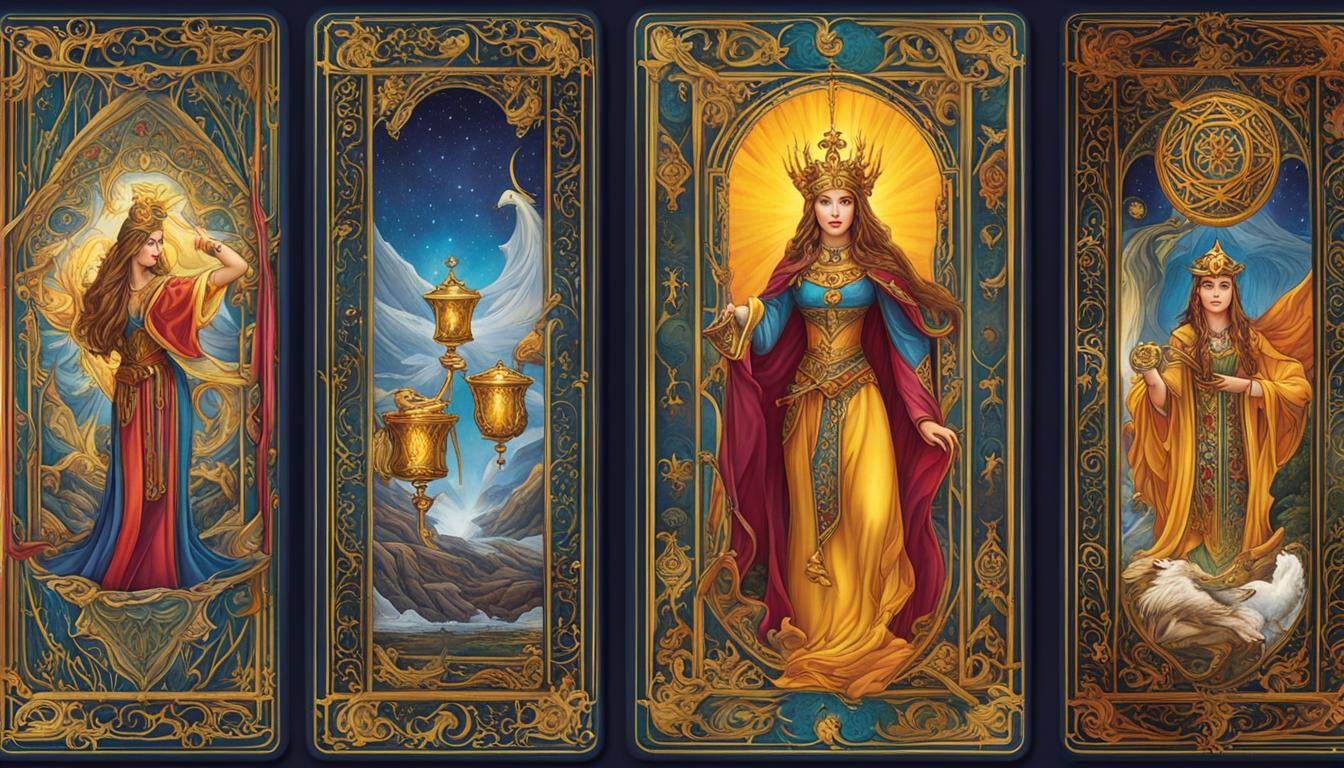
When it comes to tarot card readings, court cards often pose a challenge for many. These cards represent specific people, personality traits, or approaches to life. Think of them as different personality types defined by psychologists. Each court card carries its own unique characteristics, such as being outgoing or reserved, and processing information analytically or intuitively. With 16 court cards in a tarot deck, including the King, Queen, Knight, and Page for each suit, understanding their ranks and suits is crucial for interpreting their meanings in tarot readings.
Key Takeaways:
- Court cards in tarot decks represent specific people, personality traits, or approaches to life.
- Each court card has its own unique characteristics and symbolism.
- There are 16 court cards in a tarot deck, with four court cards for each suit – King, Queen, Knight, and Page.
- Understanding the ranks and suits of court cards is essential for interpreting their meanings in tarot readings.
- Combining the rank, suit, and intuition is key to interpreting court cards accurately.
The Four Suits of Court Cards in Tarot
In tarot, the court cards are divided into four suits: Cups, Pentacles, Swords, and Wands. Each suit represents a different aspect of life and possesses its own unique characteristics and symbolism.
The first suit, Cups, is associated with emotions, relationships, and matters of the heart. These court cards reflect the realm of feelings, intuition, and creativity. They represent individuals who are empathetic, nurturing, and in touch with their emotions.
The second suit, Pentacles, pertains to the material world, finances, and practical matters. These court cards embody qualities such as stability, hard work, and abundance. They represent individuals who are grounded, resourceful, and focused on material achievements.
The third suit, Swords, relates to intellect, communication, and decision-making. These court cards symbolize mental clarity, analytical thinking, and the power of words. They represent individuals who are intelligent, logical, and skilled in problem-solving.
The fourth suit, Wands, represents creativity, passion, and personal growth. These court cards embody energy, enthusiasm, and a zest for life. They represent individuals who are ambitious, adventurous, and driven to pursue their goals.
| Suit | Associated Element | Key Themes |
|---|---|---|
| Cups | Water | Emotions, intuition, relationships |
| Pentacles | Earth | Finances, practical matters, material abundance |
| Swords | Air | Intellect, communication, decision-making |
| Wands | Fire | Creativity, passion, personal growth |
Understanding the four suits of court cards in tarot is essential for interpreting their meanings and messages in readings. By recognizing the elemental correspondences and associated themes, you can delve deeper into the interpretations and insights that these cards provide.
The Four Ranks of Court Cards in Tarot
In tarot, the court cards can be further categorized into four ranks: Page, Knight, Queen, and King. Each rank holds its own unique characteristics and symbolism, adding depth to the interpretation of court cards.
The Page represents youthful energy, curiosity, and learning. They are often associated with new beginnings and fresh perspectives. The Knight, on the other hand, embodies action, movement, and drive. They symbolize ambition and the pursuit of goals. The Queen possesses nurturing qualities, compassion, and emotional intelligence. They are often seen as compassionate leaders and caretakers. Lastly, the King represents authority, power, and wisdom. They are the embodiment of leadership and possess a strong sense of responsibility.
Understanding the ranks of court cards is crucial in interpreting their meanings in tarot readings. Each rank brings its own energy and perspective to the reading, providing valuable insights and guidance. Whether it’s the youthful enthusiasm of the Page, the driven ambition of the Knight, the compassionate nature of the Queen, or the wise authority of the King, the ranks of court cards offer a well-rounded understanding of the human experience and the various roles we play in life.
| Rank | Suit | Keywords |
|---|---|---|
| Page | Cups, Pentacles, Swords, Wands | Youthful, Curious, Learning |
| Knight | Cups, Pentacles, Swords, Wands | Action, Movement, Drive |
| Queen | Cups, Pentacles, Swords, Wands | Nurturing, Compassionate, Emotional Intelligence |
| King | Cups, Pentacles, Swords, Wands | Authority, Power, Wisdom |
The Four Ranks of Court Cards in Tarot
Each rank of court cards in tarot brings a distinct energy and meaning to the reading. Understanding the ranks of court cards allows for a deeper interpretation of their significance in tarot readings, providing valuable insights into different aspects of life. By recognizing the unique characteristics of the Page, Knight, Queen, and King, you can gain a comprehensive understanding of the human experience and the roles we play in various situations.
Interpretation of Court Cards in Tarot
When it comes to interpreting court cards in tarot, it’s important to consider both the rank and suit of each card, as well as tapping into your intuition. These cards offer valuable insights into various aspects of life and can be used to gain a deeper understanding of situations and relationships.
Each court card represents a specific personality type or approach to life. By combining the characteristics of the rank (Page, Knight, Queen, or King) with the qualities of the suit (Cups, Pentacles, Swords, or Wands), you can unlock their meanings and symbolism in readings. For example, a Queen of Cups may symbolize emotional intelligence and nurturing qualities, while a Knight of Swords may represent action, ambition, and a sharp intellect.
When interpreting court cards, trust your intuition and personal connection with the cards. Take note of the imagery, symbolism, and colors present in each card, as they can provide additional clues and insights. Consider the positioning of the court cards in a reading, as well as their interactions with other cards, to gain a more nuanced understanding of their implications.
Understanding Court Card Symbolism
Each court card in tarot has its own unique symbolism and meaning. Looking at the traditional interpretations of each card can provide a helpful starting point, but it’s important to also explore your own associations and impressions. Allow yourself to tap into your own intuitive wisdom to uncover deeper layers of meaning within the court cards.
“The court cards are like mirrors that reflect different aspects of ourselves and the people and influences around us. They offer a window into the complexities of human nature and can provide guidance and insight when approached with an open mind and heart.” – Tarot Practitioner
Remember that interpretations of court cards may vary depending on the context of the reading and the specific question or situation at hand. Trust your own instincts and understanding of the cards, as you are the best interpreter of your own unique tarot readings.
| Ranks | Suits | Keywords |
|---|---|---|
| Page | Cups | Curiosity, youthful energy, emotional exploration |
| Knight | Pentacles | Ambition, determination, practicality |
| Queen | Swords | Intellect, communication, independence |
| King | Wands | Leadership, passion, creativity |
Using Court Cards to Represent People, Yourself, or Influences
Court cards in tarot can serve as powerful tools for understanding and interpreting the various aspects of life, including the representation of people, reflections of oneself, and influences within a given situation. By exploring the meanings and symbolism behind court cards, you can gain valuable insights that deepen your tarot readings.
When court cards appear in a reading, they may indicate specific individuals who are relevant to the situation at hand. Each court card is associated with distinct personality traits and characteristics that can help you identify the people they represent. For example, the King of Cups may represent a compassionate and emotionally intelligent individual, while the Queen of Swords may symbolize a strong and assertive person.
In addition to representing others, court cards can also act as reflections of yourself. They can provide insight into your own strengths, weaknesses, and personality traits. By exploring the court card that aligns with your birthdate or zodiac sign, you can gain a deeper understanding of yourself and discover areas for personal growth.
Furthermore, court cards can serve as influences within a given situation. They can provide guidance on how to approach challenges or opportunities. For instance, the Knight of Wands may signify the need for action and assertiveness when faced with a new project or endeavor. Understanding the influence of court cards can help you make more informed decisions and navigate through life’s complexities.
By incorporating court cards into your tarot readings, you can tap into their diverse meanings and symbolism to gain a comprehensive understanding of people, yourself, and the influences at play. Remember, trust your intuition and allow the energy of the court cards to guide you as you explore their deeper significance.
Key Takeaways:
- Court cards in tarot can represent specific individuals relevant to a situation.
- They can also act as reflections of oneself, providing insight into personal strengths and weaknesses.
- Court cards can serve as influences, offering guidance on how to approach challenges or opportunities.
- By incorporating court cards into tarot readings, you can deepen your understanding and gain valuable insights.
Conclusion
Understanding court cards in tarot is essential for unlocking their meanings and symbolism in readings. By combining the ranks and suits of court cards with intuition, you can interpret their implications accurately. Each court card represents specific people, personality traits, or influences, providing valuable insights into various aspects of life.
When interpreting court cards, it’s important to trust your intuition and personal connection with the cards. Let your instincts guide you as you delve into the depths of their symbolism. Whether they represent individuals in your life, reflect aspects of your own personality, or signify influences in a situation, court cards have the power to reveal profound insights.
As you embark on your own tarot journey, remember that practice and experience will enhance your understanding of court cards. Embrace curiosity and explore the nuances of each card. With time, you will develop a deeper connection with the court cards, allowing you to unlock their secrets and gain a greater understanding of the messages they hold.
How Are Court Cards Related to the Meaning of the Justice Card in Tarot?
The meaning of Justice card in tarot is closely related to the court cards. The court cards, representing different personality types, can symbolize the individuals involved in legal matters. When paired with the Justice card, they can indicate the presence of fairness, balance, and legal ramifications in a tarot reading.
FAQ
What are court cards in tarot?
Court cards in tarot are the cards that represent specific people, personality traits, or approaches to life. They can be thought of as similar to different personality types defined by psychologists. Each court card has its own unique characteristics and symbolism.
How many court cards are there in a tarot deck?
There are 16 court cards in a tarot deck, with four court cards – King, Queen, Knight, and Page – for each suit.
What do the different ranks and suits of court cards represent?
The different ranks and suits of court cards represent various aspects of life. The suits – Cups, Pentacles, Swords, and Wands – each have their own set of characteristics. The ranks – Page, Knight, Queen, and King – also have their own unique symbolism.
How do you interpret court cards in tarot readings?
Interpreting court cards in tarot requires combining the rank and suit of each card with your intuition. They can be interpreted as representations of specific people, reflections of oneself, or influences in a situation.
What are court cards used for in tarot readings?
Court cards are used in tarot readings to provide insights into various aspects of life. They can represent people, reflect aspects of the self, or indicate influences in a situation.