
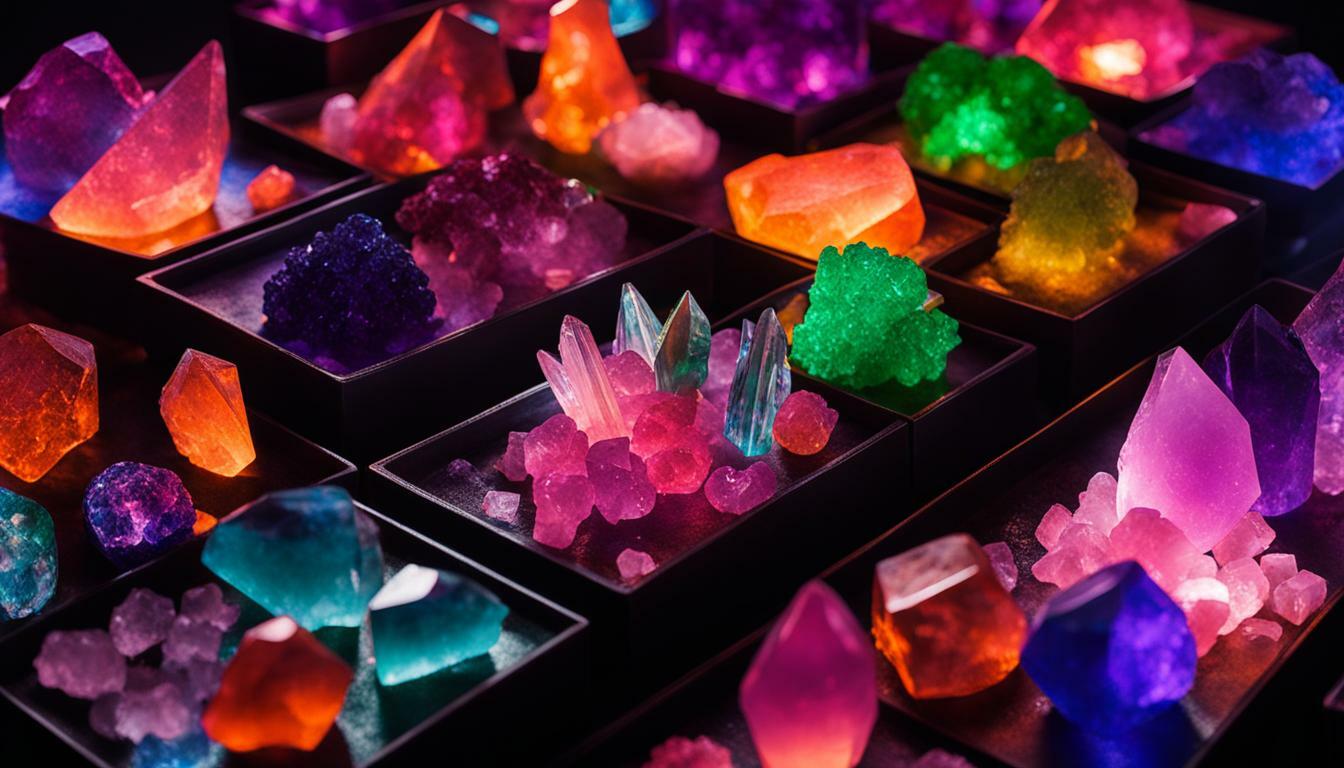
Have you ever wondered which crystals have the mesmerizing ability to glow under black light? Look no further, as we delve into the captivating world of UV reactive crystals. When exposed to ultraviolet (UV) light or black light, certain crystals emit a vibrant and enchanting display of visible light. This phenomenon, known as fluorescence, has intrigued scientists and crystal enthusiasts for centuries.
Fluorescent minerals, which encompass a wide range of crystals, can emit light of various colors when exposed to UV light. Popular examples of crystals that fluoresce under UV light include fluorite, calcite, aragonite, opal, apatite, chalcedony, corundum (ruby and sapphire), scheelite, selenite, smithsonite, sphalerite, and sodalite. The unique ability of these crystals to emit visible light under specific lighting conditions is a result of the presence of activators. These activators can either be elemental components or impurities within the crystal structure.
The practical applications of fluorescence extend beyond aesthetics. Fluorescent minerals play a crucial role in various fields such as mining, gemology, petrology, and mineralogy. Their distinct fluorescence patterns can assist in identifying minerals, distinguishing gemstone quality, studying geological formations, and even locating valuable mineral deposits.
Key Takeaways:
- Fluorescent minerals emit visible light under UV light or black light.
- Common crystals that glow under UV light include fluorite, calcite, aragonite, opal, apatite, chalcedony, corundum, scheelite, selenite, smithsonite, sphalerite, and sodalite.
- Fluorescence is caused by specific elements, known as activators, within the crystal structure.
- Fluorescent minerals have practical applications in mining, gemology, petrology, and mineralogy.
- UV lamps designed for fluorescent mineral viewing are used to observe and study these crystals.
What Causes Crystals to Glow Under Black Light?
The enchanting glow of crystals under black light is a result of specific elements within their atomic structures and the interaction with ultraviolet light. Let’s explore the fascinating mechanism behind this captivating phenomenon.
Fluorescence in crystals occurs when certain elements, known as activators, are present within their atomic structures. These activators can be essential parts of the crystal’s composition or impurities. When exposed to ultraviolet light, also known as black light, these activators absorb the UV radiation and become excited.
As the excited electrons within the crystal’s structure temporarily jump to higher energy levels, they become unstable. When these electrons return to their original, more stable energy levels, they release the excess energy in the form of visible light. This emitted light is what creates the mesmerizing glow that we see when crystals are placed under black light.
It’s important to note that not all crystals exhibit fluorescence under black light. However, there are several well-known crystals that are known to light up under a blacklight. Some examples include fluorite, calcite, apatite, corundum, aragonite, scheelite, and selenite gypsum. These crystals have specific elements within their atomic structures that are particularly prone to the fluorescence effect when exposed to UV light.
| Crystal | Fluorescent Color |
|---|---|
| Fluorite | Various colors, including blue, purple, and green |
| Calcite | Red, orange, blue, or green |
| Apatite | Yellow, green, or blue |
| Corundum (Ruby and Sapphire) | Red or pink |
| Aragonite | Green or yellow |
| Scheelite | Blue or yellow |
| Selenite Gypsum | White or orange |
Fluorescent minerals, including crystals, have practical applications in various fields such as mining, gemology, petrology, and mineralogy. Their unique glow under black light can help identify specific minerals or gems, allowing for more accurate identification and assessment. Furthermore, fluorescent minerals are highly sought after by collectors and enthusiasts for their beauty and rarity.
Observing and Studying Fluorescent Minerals
To observe and study fluorescent minerals, specialized tools and techniques are used. One such tool is a UV lamp specifically designed for fluorescent mineral viewing. These lamps emit the necessary ultraviolet light to excite the electrons within the minerals and reveal their fluorescence. By carefully observing the emitted light, researchers and enthusiasts can gain valuable insights into the composition and properties of these fascinating minerals.
Common Crystals That Glow Under Black Light
Prepare to be mesmerized as we explore a selection of commonly found crystals that beautifully glow under the captivating light of a black light. Fluorescent minerals are a marvel of nature, exhibiting a stunning array of colors when exposed to ultraviolet (UV) light. Let’s delve into the enchanting world of these magical crystals and discover their mesmerizing glow.
One of the most well-known fluorescent minerals is fluorite. This vibrant gemstone can display a range of colors, including purple, green, and blue, when illuminated by a black light. Calcite is another captivating crystal that exhibits fluorescence, often emitting a vibrant orange or red glow. Apatite, with its mesmerizing hues of blues and greens, is also known for its captivating fluorescence under UV light.
In addition, corundum, the mineral family that includes gemstones like ruby and sapphire, can showcase an intense red fluorescence. Aragonite, a calcium carbonate mineral, is famous for its vibrant blue glow. Scheelite, a tungsten ore, emits a bright blue-white fluorescence, while selenite gypsum, a variety of gypsum, displays a mesmerizing glow when exposed to UV light.
| Mineral | Fluorescent Color |
|---|---|
| Fluorite | Purple, Green, Blue |
| Calcite | Orange, Red |
| Apatite | Blue, Green |
| Corundum | Red |
| Aragonite | Blue |
| Scheelite | Blue-White |
| Selenite Gypsum | White |
These are just a few examples of the many crystals that illuminate our world with their radiant glow. Their fluorescence is a testament to the mesmerizing beauty and complexity of the natural world. Whether you are a crystal enthusiast, a collector, or simply appreciate the wonders of nature, witnessing the dazzling display of these fluorescent minerals under a black light is truly captivating.
How Fluorescence Works in Crystals
Let’s unravel the science behind fluorescence in crystals and understand how these captivating gemstones emit their radiant glow under the influence of ultraviolet light. Fluorescence is a fascinating phenomenon that occurs when certain minerals and crystals absorb ultraviolet light and re-emit it as visible light. This gives them a vibrant glow that can range from soft pastels to vivid hues.
The key to fluorescence lies in the atomic structure of these crystals. In some cases, specific elements within the crystal lattice act as activators, absorbing energy from the incoming ultraviolet light. This energy excites the electrons within these elements, causing them to temporarily jump to higher energy levels or orbitals.
As the electrons return to their original energy levels, they release the excess energy in the form of visible light. The color of the emitted light depends on the specific elements and impurities present in the crystal. This process is known as photoluminescence, and it is what creates the mesmerizing glow that we see when these crystals are exposed to ultraviolet light.
| Common Minerals That Glow Under UV Light |
|---|
| Fluorite |
| Calcite |
| Apatite |
| Corundum |
| Aragonite |
| Scheelite |
| Selenite Gypsum |
This phenomenon of fluorescence in crystals is not only visually stunning but also has practical applications. In mining, fluorescent minerals can help identify mineral-rich areas, aiding in exploration. Gemologists use fluorescence as a tool to distinguish between natural and synthetic gemstones, as well as to evaluate their quality and origin. Petrologists and mineralogists also utilize fluorescence for research purposes, studying the composition and characteristics of various minerals.
To observe and study fluorescent minerals, specialized UV lamps are used. These lamps emit ultraviolet light at specific wavelengths that are optimal for exciting the electrons in the crystals. By shining the UV light on the minerals, scientists and enthusiasts can witness the vivid fluorescence firsthand and explore the unique properties of these captivating gemstones.
Overall, the science behind fluorescence in crystals is a captivating field of study that unravels the interplay between light and matter. It allows us to appreciate the beauty and diversity of these gemstones, as well as utilize their unique properties in various practical applications. So next time you come across a crystal that glows under black light, take a moment to marvel at the fascinating science behind its radiant glow.
Practical Applications of Fluorescent Minerals
Beyond their aesthetic appeal, fluorescent minerals have found valuable applications in diverse fields. Let’s discover the practical uses of these mesmerizing gemstones.
One of the prominent applications of fluorescent minerals is in mining. Fluorescence can be used as a tool to identify specific mineral deposits, making it easier for miners to locate valuable resources. By using ultraviolet lamps, miners can quickly differentiate between fluorescent and non-fluorescent minerals, streamlining the mining process and increasing efficiency.
Gemologists also rely on the fluorescence of minerals in their work. By examining the fluorescence patterns of gemstones, experts can authenticate precious stones and determine their quality. This knowledge is crucial in evaluating gemstone value, ensuring transparency in the gem trade, and preventing the circulation of fake or treated gemstones.
Petrologists and mineralogists utilize fluorescent minerals in their research and studies. Fluorescence can provide valuable insights into the formation, composition, and geological history of rocks and minerals. By analyzing the fluorescence characteristics, experts can gain a deeper understanding of geological processes and make significant contributions to the field of earth sciences.
| Field | Practical Applications |
|---|---|
| Mining | Identification of mineral deposits |
| Gemology | Authentication and quality evaluation of gemstones |
| Petrology | Insights into rock formation and composition |
| Mineralogy | Contributions to the study of minerals and their properties |
Fluorescent minerals have proven to be invaluable tools in these industries, enabling professionals to make accurate identifications, evaluations, and scientific discoveries. The captivating glow of these minerals not only adds beauty to the natural world but also enhances our understanding of the Earth’s geological processes.
Observing and Studying Fluorescent Minerals
To fully appreciate the mesmerizing beauty of fluorescent minerals, specialized tools such as UV lamps are used to observe and study these radiant gems. UV lamps emit ultraviolet light, which causes certain minerals to fluoresce and emit visible light. This allows mineral enthusiasts and researchers to explore the unique colors and patterns displayed by these minerals when exposed to UV light.
When observing fluorescent minerals, it’s important to have a dark room or environment to enhance the visibility of the fluorescence. The UV lamp is then used to illuminate the minerals, bringing out their vibrant glow. By carefully examining the minerals under UV light, experts can identify and categorize different types of fluorescence, such as phosphorescence or shortwave and longwave UV fluorescence.
Researchers studying fluorescent minerals often document their findings through photography. UV lamps help capture the intricate details and colors of the minerals, creating stunning images that showcase their fluorescence. These images serve as valuable references for future studies and contribute to the overall understanding of fluorescence in minerals.
In addition to UV lamps, other tools used in the observation and study of fluorescent minerals include UV filters, magnifying glasses, and spectroscopes. These tools allow for detailed examinations of the minerals’ fluorescence, as well as the identification of specific elements or impurities responsible for the glowing effect. The study of fluorescent minerals continues to provide insights into the fascinating world of minerals and their unique properties.
| Tools for Observing and Studying Fluorescent Minerals | Benefits |
|---|---|
| UV Lamps | Illuminate minerals to enhance visibility of fluorescence |
| UV Filters | Remove unwanted light to focus on fluorescence |
| Magnifying Glasses | Zoom in on mineral details for closer inspection |
| Spectroscopes | Identify specific elements or impurities causing fluorescence |
The use of these tools, combined with a deep appreciation for the natural wonders of fluorescent minerals, allows enthusiasts and researchers alike to delve into the captivating world of fluorescence and discover the hidden beauty within these extraordinary gems.
Conclusion
What Crystals Glow Under Black Light has taken you on an illuminating journey into the captivating world of fluorescent crystals. From understanding the science behind their glow to exploring their practical applications, you now possess a deeper appreciation for the radiant allure of these UV-reactive gems.
Throughout this article, we have seen that certain crystals have a special ability to emit visible light under ultraviolet (UV) light or black light. This phenomenon, known as fluorescence, is caused by specific elements called activators within the crystals’ atomic structure. When exposed to UV light, these activators excite electrons, causing them to jump to higher energy levels. As these electrons return to their original orbitals, they release energy in the form of visible light, creating a mesmerizing glow.
Common examples of crystals that exhibit fluorescence include fluorite, calcite, apatite, corundum, aragonite, scheelite, and selenite gypsum. These crystals showcase a dazzling array of colors when illuminated by UV light, adding an enchanting touch to jewelry, art, and decorative pieces.
Furthermore, the practical applications of fluorescent minerals extend beyond their aesthetic appeal. Industries such as mining, gemology, petrology, and mineralogy utilize fluorescence as a valuable tool for identification, exploration, and research. UV lamps specially designed for fluorescent mineral viewing enable scientists, collectors, and enthusiasts to observe and study these radiant minerals in detail.
In conclusion, the world of crystals that glow under black light offers a fascinating blend of science, beauty, and practicality. Whether you are drawn to the captivating glow of fluorescent gemstones or the scientific exploration of UV-reactive minerals, the allure of these crystals is undeniable. So, next time you encounter a black light, take a moment to observe the captivating display of fluorescence and appreciate the remarkable wonder of these UV-reactive gems.
Can Crystals That Glow Under Black Light Also Be Charged in the Sun?
Crystals charged in the sun can indeed glow under black light. These fascinating gems absorb sunlight, store the energy, and emit it as a vibrant glow when exposed to ultraviolet light.
Are Crystals for Wealth and Abundance the Same as Crystals that Glow Under Black Light?
Crystals for wealth and abundance may not be the same as crystals that glow under black light. While some crystals may possess properties believed to attract prosperity and abundance, not all of them necessarily exhibit fluorescence or glow under black light. It is important to consider specific crystal properties and intentions when seeking wealth or experiencing the visual effects of black light on crystals.
FAQ
What are fluorescent minerals?
Fluorescent minerals are those that emit visible light of various colors under ultraviolet (UV) light or black light.
Which common minerals glow under UV light?
Some common minerals that glow under UV light include fluorite, calcite, aragonite, opal, apatite, chalcedony, corundum (ruby and sapphire), scheelite, selenite, smithsonite, sphalerite, and sodalite.
What causes the fluorescence phenomenon in minerals?
The fluorescence phenomenon is caused by specific elements, known as activators, present within the mineral. These activators can be essential parts of the crystal structure or impurities.
Can crystals also exhibit fluorescence?
Yes, crystals, which are perfectly crystallized minerals, can also exhibit fluorescence. For example, fluorite, calcite, apatite, corundum, aragonite, scheelite, and selenite gypsum crystals are known to glow under UV light.
How does fluorescence work in crystals?
Ultraviolet light triggers fluorescence by exciting susceptible electrons within the minerals, causing them to temporarily jump to a higher orbital and emit visible light when they fall back to their original orbitals.
What are the practical uses of fluorescent minerals?
Fluorescence has practical uses in various fields, such as mining, gemology, petrology, and mineralogy.
How can I observe and study fluorescent minerals?
UV lamps, specifically designed for fluorescent mineral viewing, are used to observe and study these minerals.