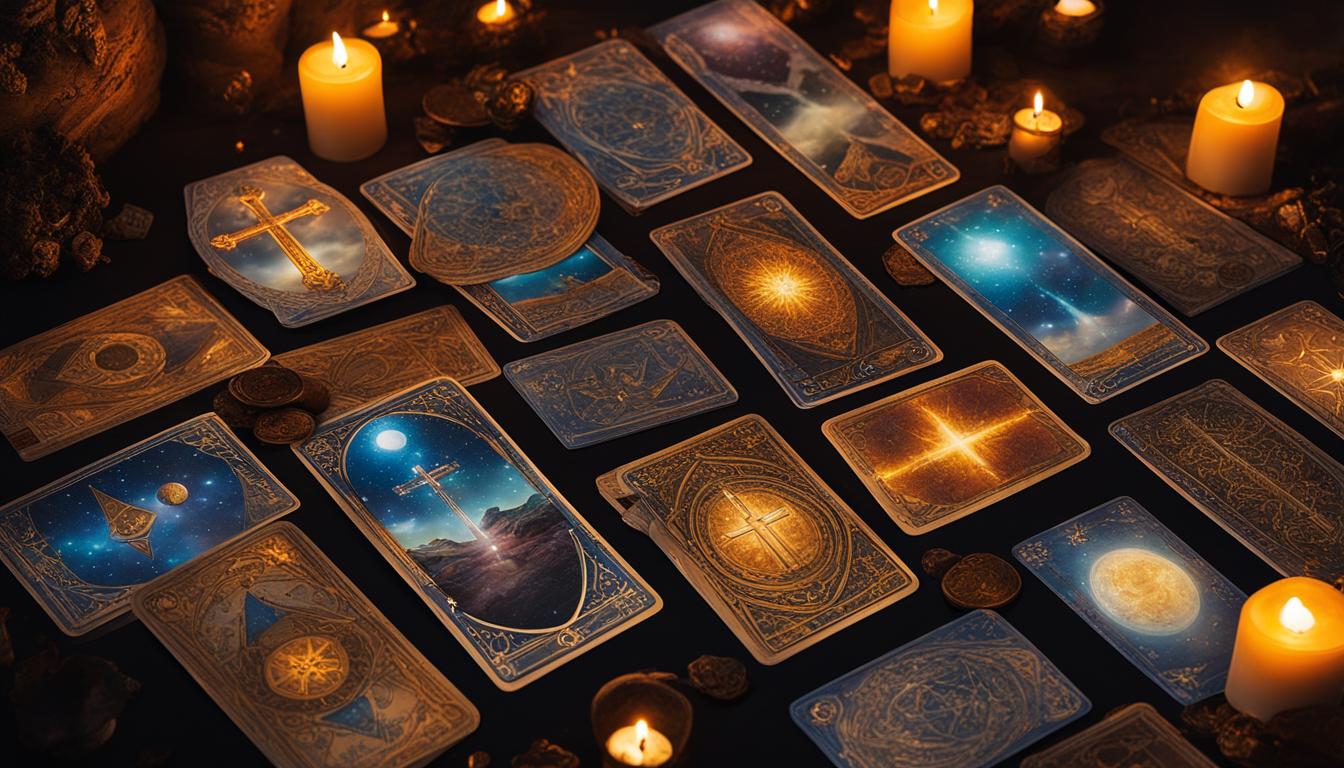
Tarot cards have long been a source of fascination for many individuals, but what religion are they actually a part of? The truth is, tarot cards do not belong to a specific religion. Instead, they can be used by people from various religious backgrounds or belief systems. The interpretation and use of tarot cards can differ depending on one’s personal beliefs and practices.
While some religions may view tarot cards as incompatible with their teachings, others may incorporate them into their spiritual practices in different ways. It’s important to understand that tarot cards themselves are not inherently religious, but they can be seen as tools for personal reflection and exploration.
Key Takeaways:
- Tarot cards do not belong to a specific religion
- They can be used by individuals from various religious backgrounds
- The interpretation and use of tarot cards vary based on personal beliefs
- Some religions may view tarot cards as incompatible with their teachings
- Tarot cards can be seen as tools for personal reflection and exploration
Tarot Cards and Different Religions
When it comes to the use of tarot cards, different religions have varying perspectives. In Christianity, for example, the Bible warns against divination and fortune-telling, which some Christians interpret as a prohibition on using tarot cards for such purposes. However, it is important to note that not all Christians hold this view. Some individuals may see tarot cards as a tool for personal insight or meditation rather than for predicting the future.
In Islam, Judaism, Hinduism, and Buddhism, there are also teachings and beliefs that may be incompatible with the use of tarot cards for divination. However, individuals within these religions might still find value in using tarot cards for personal reflection or as a tool for introspection. It is a matter of personal interpretation and belief.
Table:
| Religion | Perspective on Tarot Cards |
|---|---|
| Christianity | Some Christians view tarot cards as incompatible with their faith due to their association with divination, while others use them for personal insight or meditation. |
| Islam | Islam generally discourages the use of tarot cards for divination purposes, but individuals may still use them for personal reflection. |
| Judaism | Divination is generally discouraged in Judaism, but some individuals may use tarot cards for introspection or as a psychological tool. |
| Hinduism | Hinduism does not have a unified view on tarot cards, and individual beliefs may vary. Some may see them as a tool for personal reflection. |
| Buddhism | Buddhism focuses on mindfulness and meditation, and some individuals within the religion may use tarot cards as a tool for introspection. |
Christian Perspectives on Tarot Cards
Within Christianity, there is a range of perspectives on tarot cards. Some Christians believe that tarot cards are inherently against their faith due to their association with divination, while others may view them as permissible tools for personal growth and spiritual exploration. Many modern Christians base their beliefs and practices on the teachings of the New Testament, focusing on love, compassion, and personal relationship with God. This allows some Christians to use tarot cards in a way that aligns with their faith, using them as a tool for self-reflection, meditation, or exploring archetypes without seeking to predict the future or engage in fortunetelling.
It is important to note that not all Christian denominations or individuals endorse the use of tarot cards. Some may argue that tarot cards are incompatible with biblical teachings, particularly those that caution against seeking out occult practices or relying on divination. For these individuals, tarot cards may be seen as a potential gateway to spiritual deception or misguided beliefs. However, there are also Christians who view tarot cards as a means of self-discovery and personal insight, using them as a tool for introspection and reflection.
As with any religious or spiritual practice, it is necessary to approach the use of tarot cards with discernment and adherence to one’s individual beliefs. While tarot cards may hold value and meaning for some Christians, it is important to respect the diverse perspectives within the Christian community and not impose one’s own beliefs onto others. Ultimately, the decision to use tarot cards within the context of Christian spirituality rests with the individual and their understanding of their faith.
Christian Perspectives on Tarot Cards – Quotes
“I believe that tarot cards can be a tool for personal growth and self-reflection, helping us gain insights into our own thoughts and emotions.” – Sarah, Christian tarot card user
“As Christians, we are called to rely on God’s guidance and not seek answers through fortune-telling or divination practices like tarot cards.” – Mark, Christian against the use of tarot cards
Christian Perspectives on Tarot Cards – Summary
- Christian perspectives on tarot cards vary, with some Christians viewing them as compatible with their faith and others seeing them as incompatible.
- Modern Christians who use tarot cards often do so for self-reflection, meditation, and exploring archetypes, rather than seeking to predict the future.
- Some Christians believe that tarot cards are incompatible with biblical teachings and caution against engaging in occult practices or relying on divination.
- Respect for different beliefs is important, as Christians have diverse perspectives on the use of tarot cards within the context of their faith.
| Pros | Cons |
|---|---|
| Can be used for personal growth and self-reflection | Some Christians view them as incompatible with biblical teachings |
| Allow for exploration of archetypes and personal insight | May be seen as a potential gateway to spiritual deception for some |
| Can enhance one’s understanding of their own thoughts and emotions | Not endorsed by all Christian denominations or individuals |
Interpretation and Personal Beliefs
When it comes to tarot cards, personal beliefs play a significant role in how they are interpreted and used. Each individual brings their unique perspective and understanding to the cards, resulting in a personalized experience. Tarot cards have a rich symbolism that can be interpreted in various ways, depending on one’s beliefs and intuition.
For some, tarot cards are seen as a personal tool for self-reflection and introspection. They provide a means to delve into one’s thoughts, emotions, and experiences. The symbolism within the cards acts as a mirror, allowing individuals to gain insights and perspectives on their own lives. This personalized approach to tarot cards can lead to personal growth and a deeper understanding of oneself.
It is important to note that tarot cards are not tied to any specific religious or belief system. They can be embraced by individuals of diverse backgrounds and practices. As such, the interpretation of tarot cards varies greatly based on individual beliefs and preferences. Some may view tarot cards as a spiritual connection to higher insights or guidance, while others may perceive them as a psychological tool for self-reflection and exploration.
Individual Interpretation
With tarot cards, each person has the freedom to interpret the symbolism and meaning in their own way. The cards act as a catalyst for personal intuition and reflection. The interpretation process involves drawing upon one’s own experiences, emotions, and knowledge to gain insights and understanding.
“Tarot cards are like a language that speaks to your soul. By tuning in to the imagery and symbolism, you can uncover hidden truths and find guidance in your own unique way.” – Tarot enthusiast
By allowing for individual interpretation, tarot cards become a highly personal and meaningful tool. The insight gained through the cards can facilitate personal growth, self-awareness, and decision-making. This individualized approach to tarot cards empowers individuals to connect with their inner wisdom and navigate life’s journey with clarity and confidence.
| Personal Beliefs about Tarot Cards | Individual Interpretation of Tarot Cards | Tarot Cards as a Personal Tool |
|---|---|---|
| Varies based on individual beliefs and practices | Dependent on personal intuition, experiences, and knowledge | Allows for self-reflection, introspection, and personal growth |
| Can be spiritual, psychological, or a combination | Act as a catalyst for personal insight and understanding | Empowers individuals to connect with their inner wisdom |
Tarot Cards as Archetypes and Symbols
Tarot cards are not only tools for divination but also contain deep symbolic meanings and archetypes that can provide insight and reflection into various aspects of life. Each card in the tarot deck represents a specific archetype or symbol, offering a lens through which we can explore our own experiences, emotions, and challenges.
The symbolism in tarot cards is rich and diverse, drawing from a range of mythologies, spiritual traditions, and universal human experiences. For example, the Fool card symbolizes new beginnings, taking risks, and embracing the unknown. The High Priestess represents intuition, wisdom, and the mysteries of the subconscious mind. The Death card signifies transformation, letting go of the old to make way for the new.
By engaging with tarot cards and their symbolism, individuals can tap into their own subconscious and gain insights into their thoughts, feelings, and circumstances. It allows for self-reflection, offering a mirror to examine our emotions, relationships, and life choices. Tarot cards can serve as reflective tools, providing a fresh perspective and guiding us towards a deeper understanding of ourselves.
The Power of Symbolism
Symbolism is a powerful tool for personal growth and self-discovery. It bypasses the limitations of language and taps into our subconscious, allowing for a more intuitive and holistic exploration of our inner world. Tarot cards serve as a visual language of symbols, enabling us to access subconscious knowledge and make connections that might otherwise remain hidden.
“The tarot is a mirror that reflects aspects of ourselves, our experiences, and the collective human journey. It invites us to delve into our own subconscious, confront our fears and desires, and gain a deeper understanding of who we are.” – Tarot practitioner
Whether used for personal reflection, meditation, or as a tool for self-discovery, tarot cards allow us to explore the layers of meaning and symbolism that exist within ourselves and the world around us. They can guide us on a journey of self-exploration, helping us uncover insights, find clarity, and navigate the complexities of life.
| Tarot Card | Symbolism |
|---|---|
| The Fool | New beginnings, spontaneity, embracing the unknown |
| The High Priestess | Intuition, wisdom, the mysteries of the subconscious mind |
| The Death | Transformation, letting go of the old to make way for the new |
Personal Use of Tarot Cards
Tarot cards can have a profound impact on personal growth and self-reflection. Many individuals use tarot cards as a tool to delve into their inner thoughts, emotions, and experiences. By connecting with the symbolism and archetypes represented in the cards, you can gain valuable insights into your own life and navigate life’s challenges.
Using tarot cards for self-reflection allows you to explore different perspectives and gain a deeper understanding of yourself. Each card carries its own meaning, and as you interpret and analyze them, you can uncover hidden aspects of your personality or gain clarity on specific situations or relationships. Tarot cards can provide guidance and serve as a mirror to your subconscious mind.
“Tarot cards are like a compass that points you in the right direction. They have a way of tapping into your intuition and bringing forth messages that you may not have considered otherwise.”
In addition to self-reflection, tarot cards can also be used for meditation. By focusing on a specific card or spread, you can enter a meditative state and allow the imagery and symbolism to guide your thoughts and emotions. This practice can help bring about a sense of calm, clarity, and spiritual connection.
It is important to approach your personal use of tarot cards with an open mind and a willingness to explore. Embrace the opportunity to learn more about yourself, tap into your intuition, and embark on a journey of self-discovery.
Respect for Different Beliefs and Practices
When discussing tarot cards and spirituality, it is crucial to approach the topic with respect for the diverse beliefs and practices of individuals. People hold various religious and spiritual beliefs, and these can greatly influence their perspectives on tarot cards. Some may view tarot cards as an integral part of their religious or spiritual practice, while others may have reservations or consider them incompatible with their belief system.
In fostering a climate of respect, it is important to recognize and honor the freedom individuals have in choosing their own spiritual paths. Tarot cards can hold different meanings and significance depending on an individual’s personal beliefs and practices. By acknowledging and understanding these diverse perspectives, we can create an environment that encourages open-mindedness and tolerance.
Tolerance of diverse spiritual practices involves recognizing that each person’s spiritual journey is unique and should be respected. It is not our place to judge or dismiss someone else’s beliefs or practices simply because they differ from our own. Instead, we can seek to understand the reasons behind these beliefs and practices and engage in constructive dialogue that promotes mutual understanding and respect.
By fostering an atmosphere of respect for different beliefs and practices, we can create a space where individuals feel comfortable sharing their experiences and perspectives without fear of judgment or exclusion. This allows for meaningful conversations and the promotion of empathy, compassion, and inclusivity. Together, we can celebrate the diversity of human spirituality and learn from one another’s unique perspectives.
Table: Comparative Overview of Religious Perspectives on Tarot Cards
| Religion | Perspective on Tarot Cards |
|---|---|
| Christianity | Varies from prohibition to personal use for reflection and meditation |
| Islam | Generally considered incompatible with Islamic teachings |
| Judaism | Generally considered incompatible with Jewish beliefs and practices |
| Hinduism | Varies; some may use tarot cards for personal reflection or introspection |
| Buddhism | Varies; some may incorporate tarot cards into their own spiritual practices |
Conclusion
In conclusion, tarot cards do not belong to a specific religion, allowing individuals from various religious backgrounds or belief systems to use them. While some religions may view tarot cards as incompatible with their teachings, others may incorporate them into their spiritual practices in different ways. The interpretation and use of tarot cards are influenced by personal beliefs and practices, making it a personal and individual experience.
It is important to understand and respect the diverse perspectives on tarot cards. Different individuals have varying beliefs and practices when it comes to tarot cards and spirituality. Recognizing and honoring the freedom individuals have in choosing their own spiritual paths is essential. Engaging in discussions about tarot cards with an open mind, showing respect for diverse beliefs and practices, will foster understanding and tolerance among different individuals.
Ultimately, each person has the freedom to determine their own relationship with tarot cards based on their unique beliefs and understanding. Tarot cards can be used as a tool for personal reflection, meditation, self-awareness, and growth. Whether you see them as a spiritual tool or a psychological aid, the choice is yours. Embrace the diversity of perspectives and approaches towards tarot cards, and embark on your personal journey of exploration and self-discovery.
Are Tarot Cards Specifically Tied to a Certain Religion?
Some people believe that tarot cards and religion are intrinsically linked, as they have been associated with spiritual practices such as Wicca and Paganism. However, tarot cards themselves are not tied to any specific religion and can be used by people of various beliefs for guidance and introspection.
FAQ
Do tarot cards belong to a specific religion?
No, tarot cards do not belong to a specific religion. They can be used by individuals from various religious backgrounds or belief systems.
Can tarot cards be used by people of different religious beliefs?
Yes, tarot cards can be used by individuals of different religious beliefs. The interpretation and use of tarot cards may vary depending on personal beliefs and practices.
How do different religions view the use of tarot cards?
Different religions have varying perspectives on the use of tarot cards. Some religions may view them as incompatible with their teachings, while others may incorporate them into their spiritual practices in different ways.
What is the Christian perspective on tarot cards?
Christianity has a range of perspectives on tarot cards. Some Christians believe they are against their faith due to their association with divination, while others view them as permissible tools for personal growth and spiritual exploration.
How are tarot cards interpreted based on personal beliefs?
Tarot cards can be interpreted and used in different ways based on individual beliefs and preferences. Each person establishes their own relationship with tarot cards based on their unique perspective and beliefs.
What is the significance of tarot cards as archetypes and symbols?
Tarot cards are often seen as a collection of archetypes and symbols that represent different aspects of human experiences and emotions. Each card carries its own meaning and can be interpreted as a reflection of various situations, emotions, or challenges.
How can tarot cards be used for personal purposes?
Many individuals use tarot cards for personal purposes that are not necessarily tied to any religion or belief system. Tarot cards can be used as a tool for self-reflection, introspection, and meditation to deepen self-awareness and navigate life’s challenges.
How should different beliefs and practices regarding tarot cards be respected?
It is essential to respect and understand that different individuals have varying beliefs and practices when it comes to tarot cards and spirituality. Each person’s spiritual journey is unique, and it is important to recognize and honor the freedom individuals have in choosing their own spiritual paths.