
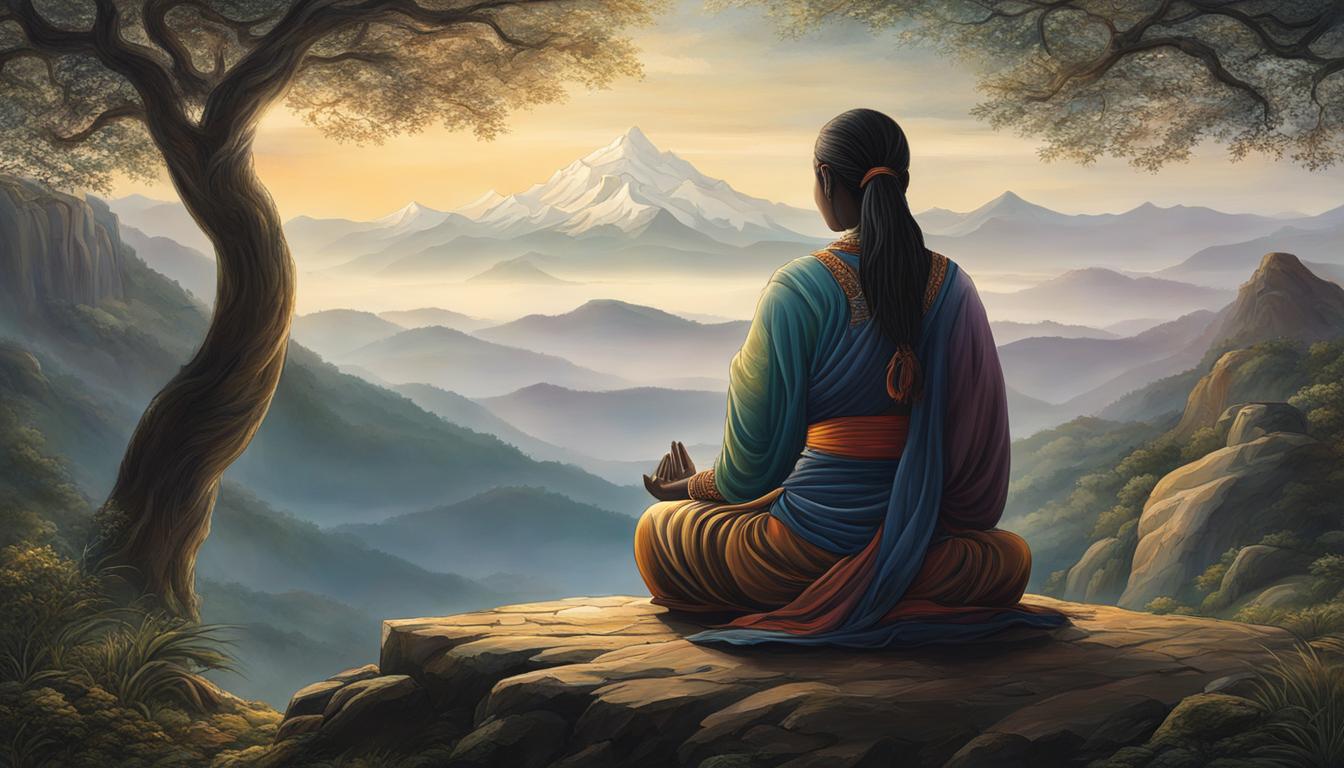
Meditation has a rich and ancient history that spans across cultures and civilizations. The origins of meditation can be traced back thousands of years to the beginnings of human civilization. While it’s difficult to pinpoint the exact origins due to the oral transmission of ancient practices, research suggests that meditation has been a part of human culture since time immemorial.
The term “meditation” originates from the Latin word “meditatum,” which means “to ponder.” It was practiced in ancient animistic religions and shamanic traditions, where individuals would engage in deep contemplation and reflection. The earliest written records of meditation come from the Hindu Vedas, dating back to around 1500 BCE.
Other forms of meditation were also recorded in Taoist China and Buddhist India around 600-400 BCE. These practices varied in their techniques and philosophies, but they all aimed to cultivate inner peace, self-awareness, and spiritual connection.
Key Takeaways:
- Meditation has been a part of human culture for thousands of years
- The term “meditation” comes from the Latin word “meditatum,” meaning “to ponder”
- Ancient animistic religions and shamanic traditions practiced meditation
- The earliest written records of meditation come from the Hindu Vedas
- Other forms of meditation were recorded in Taoist China and Buddhist India
How Old Is Meditation?
Understanding the age of meditation is a challenging task due to the nature of its ancient origins and the limited written records available. However, evidence suggests that meditation has been practiced by human beings since the dawn of civilization. Psychologist Matt J. Rossano proposes that group rituals and meditations around the campfire between 200,000 and 150,000 years ago played a pivotal role in the development of our working memory, a crucial aspect of human evolution. These early meditative practices may have contributed to our ancestors’ ability to reflect, plan, and communicate effectively.
While it is difficult to pinpoint an exact timeline, meditation is believed to be as old as humanity itself. The ancient practice has been an integral part of various cultures and spiritual traditions throughout history. From the animistic religions of ancient civilizations to the Hindu Vedas, Taoist practices in China, and Buddhist traditions in India, meditation has evolved and adapted across different cultural contexts.
To fully comprehend the age of meditation, it is essential to consider the oral transmission of ancient practices. Many meditation techniques were passed down through generations before being recorded in written form. The earliest written records of meditation can be traced back to the Hindu Vedas around 1500 BCE. These ancient texts document various meditation practices in intricate detail, reflecting the deep-rooted significance of meditation in ancient Indian culture.
While the exact age of meditation may remain a mystery, its ancient beginnings and cultural significance are undeniable. The practice continues to thrive and adapt in the modern world, offering individuals a pathway to self-discovery, tranquility, and spiritual growth.
How Old Is Meditation? – A Timeline
| Period | Key Milestones |
|---|---|
| Ancient Times | – Shamanic practices and fire gazing rituals contribute to the development of meditation techniques – Meditation is an essential part of animistic religions |
| Around 1500 BCE | – The Hindu Vedas provide the earliest written records of meditation – Various meditation practices are described in detail in these ancient texts |
| Around 600-400 BCE | – Meditation practices are recorded in Taoist China and Buddhist India |
| Modern Era | – Western interest in Eastern religions leads to the popularization of meditation practices in the 20th century |
This timeline offers a glimpse into the rich and diverse history of meditation, highlighting the ancient roots and cultural significance of this transformative practice.
What Is the Origin of Meditation?
The origin of meditation is a topic of much speculation and debate due to the ancient roots of orally transmitted practices. While it is challenging to pinpoint the exact origin, various theories and historical records provide insights into the cultural origins of meditation.
One of the earliest written records of meditation practices comes from the Hindu Vedas, ancient sacred texts dating back to around 1500 BCE. These texts mention different forms of meditation and provide instructions on how to practice them. Similarly, Taoist China and Buddhist India recorded their unique meditation techniques between 600 and 400 BCE.
The ancient roots of meditation can be traced back further through oral traditions and practices such as fire gazing and shamanic guided meditations. These practices were integral to animistic religions and shamanic traditions, but their exact origins are difficult to determine.
“The exact origin of meditation cannot be pinpointed given their ancient roots in orally transmitted practices.”
Table: Cultural Origins of Meditation
| Culture | Earliest Written Records |
|---|---|
| Hindu | Around 1500 BCE in the Vedas |
| Taoist | Between 600-400 BCE in China |
| Buddhist | Between 600-400 BCE in India |
Overall, the origin of meditation is a complex and multifaceted subject that continues to be explored by scholars and practitioners alike. While we may not have a definitive answer, the historical roots of meditation highlight its deep connection to human spirituality and personal growth throughout the ages.
A Look at the Roots and Origin of Meditation
Understanding the roots and origin of meditation is a fascinating journey into the history of human spirituality. While pinpointing the exact beginnings of meditation is challenging, ancient texts and oral traditions provide valuable insights into its origins. Meditation can be traced back to the ancient Indian Vedas, with the earliest written records dating around 1500 BCE. These texts describe various meditation techniques and philosophies, offering a glimpse into the practices of the Indo-Aryan sages.
Around the same time, meditation was also recorded in Taoist China and Buddhist India. These traditions emphasized self-awareness, breathing techniques, and the cultivation of inner peace. The transmission of meditation practices through oral tradition further complicates the tracing of its precise origins. However, scholars believe that these practices existed long before they were ever written down, making meditation as old as human civilization itself.
Exploring the cultural origins of meditation reveals its universal appeal. From ancient animistic religions to Hindu, Buddhist, and Taoist traditions, meditation has played a vital role in various cultures throughout history. Each culture has contributed unique perspectives and techniques, shaping the diverse landscape of meditation as we know it today.
The Origins of Meditation in Different Cultures
The origins of meditation can be seen in different cultural contexts. In ancient India, meditation was deeply intertwined with philosophical and cosmological inquiries. The Vedas and Upanishads provided a framework for both practical and philosophical aspects of meditation. In China, Taoist meditation focused on aligning oneself with the natural flow of energy, emphasizing harmony and balance. Meanwhile, in Buddhist traditions, meditation was a fundamental practice for attaining enlightenment and understanding the nature of reality.
| Culture | Origin of Meditation |
|---|---|
| India | Ancient Hindu texts (Vedas and Upanishads) |
| China | Taoist practices |
| Buddhism | Early Buddhist texts and teachings |
As meditation traveled from East to West, it influenced and merged with indigenous practices. Druidry, the ancient Celtic tradition, incorporated meditation techniques in their spiritual practices. Early Christian monks and hermits also developed their own forms of meditation, seeking deeper connection with divine forces. In recent centuries, the interest in Eastern philosophies and practices has led to the integration of meditation into Western cultures, giving rise to various contemporary mindfulness and contemplative practices.
Overall, the roots and origin of meditation are deeply interconnected with the human quest for self-discovery, inner peace, and transcendent experiences. From ancient texts to oral traditions, the practice of meditation has evolved and adapted, shaping the rich tapestry of spiritual practices across cultures and throughout history.
A History of Meditation in the West
Contrary to popular belief, meditation is not solely an Eastern practice. The roots of meditation in the West can be traced back to ancient times. Indigenous cultures in the West, such as the ancient Celts, had their own forms of meditation. Druidry, a pre-Christian pagan tradition, incorporated meditation practices as a way to connect with nature and the spiritual realm. Similarly, early Christian monks known as the Desert Fathers and Mothers engaged in contemplative practices that can be considered a form of Christian meditation.
In the modern era, Western interest in Eastern religions and philosophies led to the introduction and popularization of meditation practices from the East. It started in the 20th century with the arrival of teachers from India and the dissemination of their teachings. This sparked a growing interest in mindfulness and other meditative practices, which have since become prominent in the West.
To understand the history of meditation in the West, it is essential to recognize the cross-cultural exchange that has taken place. Eastern practices have been integrated into Western spiritual traditions, giving rise to a diverse and evolving meditation landscape. Today, meditation is practiced by people from various religious, spiritual, and secular backgrounds, and it continues to thrive as a tool for cultivating inner peace, self-awareness, and personal growth.
Major Milestones in the Development of Meditation Practices in the East and West:
| Time Period | East | West |
|---|---|---|
| Ancient Times | Meditation practices recorded in the Hindu Vedas and Buddhist traditions | Indigenous meditation practices among ancient Celtic cultures |
| 4th-6th Century CE | The rise of Buddhism and the spread of meditation practices across Asia | Contemplative practices among Christian monks in Egypt |
| 20th Century | Introduction of Eastern meditation practices to the West, popularization of mindfulness | Integration of Eastern practices into Western spiritual traditions |
As we explore the origins and history of meditation, it becomes evident that meditation is a global phenomenon with deep cultural roots. By appreciating both the Eastern and Western contributions to meditation, we gain a broader understanding of its rich and diverse heritage.
The Beginnings of Mindfulness Meditation
Mindfulness meditation has a long and rich history that can be traced back to ancient Eastern traditions. The practice of mindfulness involves being fully present in the moment and cultivating a non-judgmental awareness of one’s thoughts, feelings, and sensations. While the exact origins of mindfulness meditation are difficult to determine, it is believed to have emerged alongside the development of yogic meditation techniques described in the ancient Indian Vedas. Early Buddhist practices such as satipaṭṭhāna also incorporated mindfulness meditation as a means of gaining insight and cultivating tranquility.
Daoism, a Chinese tradition, also emphasized self-awareness and focused on the breath as a way to still the mind and achieve a state of mindfulness. Over time, mindfulness meditation has evolved and adapted to different cultures and contexts, becoming increasingly popular in the West in recent decades.
“The practice of mindfulness involves being fully present in the moment and cultivating a non-judgmental awareness of one’s thoughts, feelings, and sensations.”
Mindfulness meditation gained significant attention and recognition in the 20th century when it was introduced to the West by Asian spiritual teachers and popularized by researchers and clinicians. The benefits of mindfulness meditation, such as stress reduction, improved well-being, and increased focus, have been scientifically studied and widely documented.
The Role of Mindfulness in Modern Society
In today’s fast-paced and digitally connected world, mindfulness meditation offers a way to counteract the constant distractions and busyness of daily life. It provides a space for individuals to cultivate inner peace, improve mental clarity, and enhance their overall well-being. Mindfulness practices, such as breath awareness and body scans, can be integrated into various aspects of life, including work, relationships, and self-care.
As mindfulness continues to gain popularity, it is being incorporated into a wide range of settings, from hospitals and schools to corporations and sports teams. The practice of mindfulness has become a valuable tool for managing stress, enhancing performance, fostering resilience, and promoting greater self-awareness.
| Mindfulness Meditation in Modern Society | Benefits |
|---|---|
| Workplace | Increased focus and productivity |
| Schools | Improved attention and emotional regulation |
| Hospitals | Reduced stress and enhanced well-being |
| Athletics | Improved performance and mental resilience |
As mindfulness meditation continues to evolve and become more integrated into various aspects of society, its ancient roots and cultural origins serve as a reminder of its enduring relevance and transformative power.
Conclusion
Meditation has a rich and diverse history that spans across cultures and millennia. The origins of meditation may be difficult to determine, but it is clear that the practice has been an integral part of human spirituality and personal growth for thousands of years.
From ancient animistic religions to Hindu Vedas, Buddhist traditions, and modern mindfulness practices, meditation continues to evolve and adapt to different cultures and contexts. Its timeless essence remains a powerful tool for cultivating awareness, inner peace, and spiritual connection.
Whether you’re interested in exploring the ancient origins of meditation or delving into the cultural roots of different traditions, understanding the history of meditation can deepen your practice and enhance your experience. So, embark on your journey of self-discovery and tap into the wisdom of the ages through the transformative practice of meditation.
What Is the Origin of Meditation and Mindfulness Practices?
The origins of mindfulness practice can be traced back to ancient Indian traditions, where meditation was used as a way to achieve spiritual awakening. Over time, these practices spread to other parts of Asia and eventually made their way to the Western world, where they have become increasingly popular for their mental and emotional benefits.
FAQ
Where Does Meditation Originate?
Meditation has been a spiritual practice since the beginnings of human civilization. While it is difficult to determine the exact origins of meditation due to the oral transmission of ancient practices, research suggests that meditation has been a part of human culture for thousands of years. It was practiced in ancient animistic religions and shamanic traditions, and the earliest written records of meditation come from the Hindu Vedas around 1500 BCE. Other forms of meditation were also recorded in Taoist China and Buddhist India around 600-400 BCE.
How Old Is Meditation?
Meditation is believed to have been a spiritual practice of human beings since our beginnings. Psychologist Matt J. Rossano proposes that group rituals and meditations around the campfire between 200,000 and 150,000 years ago helped our ancestors develop the working memory essential for human evolution. However, dating meditation is challenging without a robust definition, as most ancient practices were transmitted orally before being written down. Meditation is likely as old as humanity itself.
What Is the Origin of Meditation?
The exact origin of meditation is difficult to determine due to the ancient roots of orally transmitted practices. Fire gazing and shamanic guided meditation practices existed long before written records, and ancient Vedic practices were transmitted orally for centuries. The earliest written records of meditation come from the Hindu Vedas around 1500 BCE. Other forms of meditation were also recorded in Taoist China and Buddhist India around 600-400 BCE. Overall, the precise origins of meditation cannot be pinpointed given their ancient roots in orally transmitted practices.
A Look at the Roots and Origin of Meditation
The earliest written descriptions of meditation techniques can be found in the ancient Indian Vedas, which were first committed to writing around 1500 BCE. However, the oral transmission of these techniques makes it challenging to trace the roots and origin of meditation with accuracy. Indo-Aryan sages had been transmitting these teachings orally for hundreds of years before they were written down. Scholars speculate that the Vedas emerged around 3000 BCE as the products of the rishis’ philosophical reflections on cosmological questions. The Upanishads, the philosophical narratives that describe the techniques used by the sages, are widely cited as the earliest written records of meditation.
A History of Meditation in the West
There is a common misconception that meditation is primarily an Eastern practice, but indigenous forms of meditation have existed in the West since ancient times. Druidry, a pre-Christian pagan tradition of the ancient Celtic people, included meditation practices. Christian meditation also has roots dating back to the early Church established by the Desert Fathers and Mothers in Egypt. In the modern era, Western interest in Eastern religions and philosophies grew, leading to the popularization of meditation practices from the East in the 20th century. This timeline shows the major milestones in the development of meditation practices in both East and West.
The Beginnings of Mindfulness Meditation
Mindfulness meditation can be traced back to the first written records of yogic meditation in the ancient Indian Vedas. It was also a part of early Buddhist practices such as satipaṭṭhāna, which involves cultivating tranquil observation to gain insight. Daoism, a Chinese tradition, also includes a strong focus on breathing and self-awareness. Mindfulness meditation emphasizes being fully present in the moment and has its roots in ancient Eastern traditions.
Conclusion
Meditation has a rich and diverse history that spans across cultures and millennia. While the exact origins of meditation may be difficult to determine, it is clear that the practice has been an integral part of human spirituality and personal growth for thousands of years. From ancient animistic religions to Hindu Vedas, Buddhist traditions, and modern mindfulness practices, meditation continues to evolve and adapt to different cultures and contexts. Its timeless essence remains a powerful tool for cultivating awareness, inner peace, and spiritual connection.