
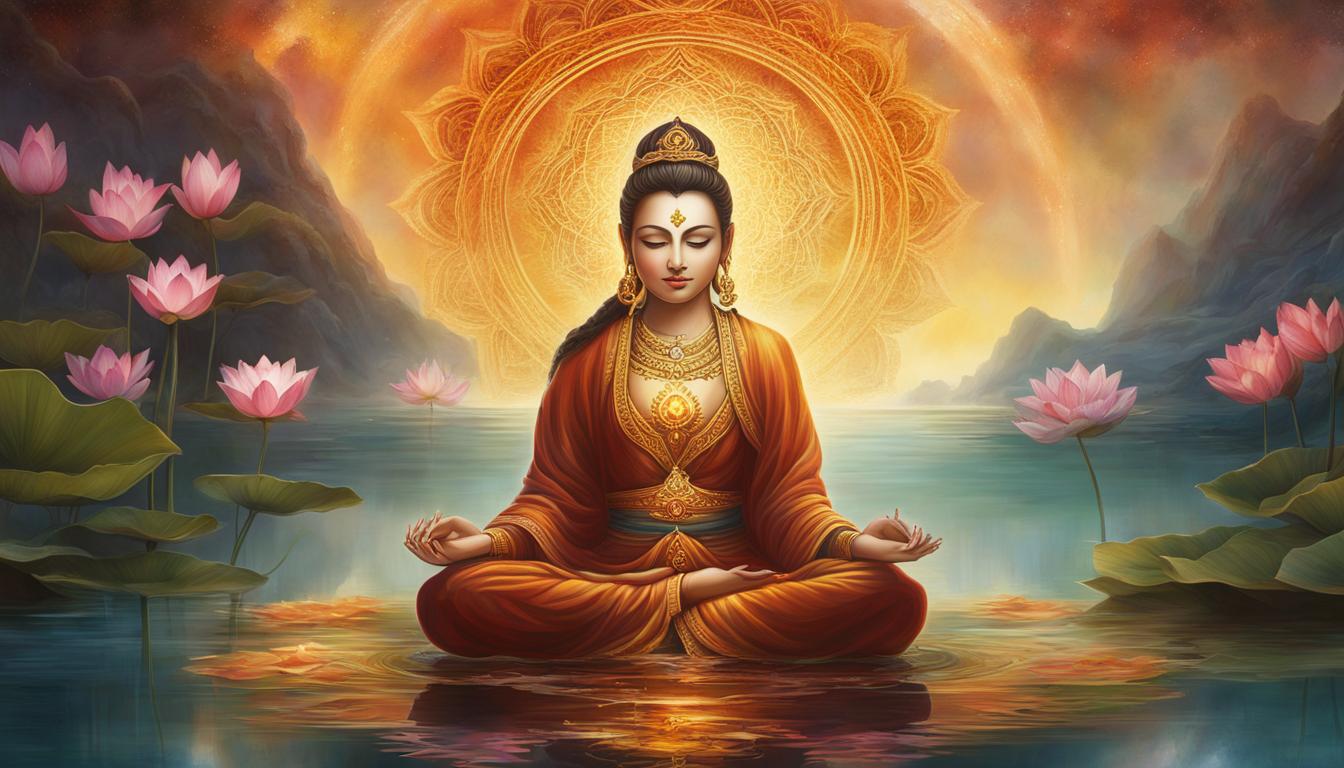
Meditation is an ancient practice that has been part of human civilization since our beginnings. The word “meditation” comes from the Latin term “meditatum,” meaning “to ponder.” It is a contemplative practice that helps us become more aware of our thoughts, feelings, and behavior. While the exact origin of meditation is difficult to determine, research suggests that it has been a spiritual practice for humans for thousands of years. Ancient animistic religions, hunter-gatherer societies, and shamanic practices all involved some form of meditation. The precise origins of meditation cannot be determined due to the oral transmission of ancient practices before they were written down.
Key Takeaways:
- The word “meditation” comes from the Latin term “meditatum,” meaning “to ponder.”
- Meditation has been a spiritual practice for humans for thousands of years.
- Ancient animistic religions, hunter-gatherer societies, and shamanic practices all involved some form of meditation.
- The precise origins of meditation cannot be determined due to the oral transmission of ancient practices before they were written down.
- Meditation helps us become more aware of our thoughts, feelings, and behavior.
How Old Is Meditation?
Meditation is an ancient practice that has stood the test of time, but determining its exact age poses a challenge. Research suggests that meditation has been a spiritual practice since the dawn of human civilization, with roots dating back thousands of years. One theory proposed by psychologist Matt J. Rossano suggests that our ancestors engaged in group rituals and meditations around 200,000 to 150,000 years ago, which played a role in the development of working memory crucial for human evolution.
Ancient animistic religions and hunter-gatherer societies incorporated meditation as part of their rituals and worship. These practices involved connecting to nature and exploring inner states of consciousness. However, due to the oral transmission of ancient traditions before they were recorded in writing, it is challenging to pinpoint the exact age of meditation.
While we may not have specific dates, we can trace meditation’s deep history through various ancient cultures and spiritual traditions. From shamanic practices to the Vedic scriptures of Hinduism, meditation has been an integral part of human life for centuries, fostering self-awareness and spiritual growth.
“Meditation is the art of reaching inside and discovering your own inner wisdom.” – Amit Ray
How Old Is Meditation? An Overview:
- Group rituals and meditations around 200,000 to 150,000 years ago laid the foundation for human evolution.
- Ancient animistic religions and hunter-gatherer societies incorporated meditation into their rituals and worship.
- The exact age of meditation is difficult to determine due to the oral transmission of ancient practices.
- Meditation’s roots can be traced back to the Vedic scriptures of Hinduism and other ancient spiritual and philosophical traditions.
Table: Ancient Meditation Practices
| Culture | Time Period | Meditation Practices |
|---|---|---|
| Ancient Animistic Religions | Prehistoric to Present | Connecting with nature, trance states, and exploring inner consciousness |
| Hinduism | Approximately 1500 BCE | Yogic meditation, mantra repetition, breath control |
| Buddhism | Approximately 600 BCE | Vipassana (insight) meditation, mindfulness |
| Daoism | Approximately 400 BCE | Guan meditation, breathing techniques, self-awareness |
What Is the Origin of Meditation?
Due to the ancient roots of meditation and the lack of written records, it is challenging to pinpoint its exact origin. However, the earliest written records of meditation come from the Hindu Vedas around 1500 BCE. Shamanic guided meditation practices also existed in ancient hunter-gatherer cultures. Other forms of meditation were recorded in Taoist China and Buddhist India around 600 and 400 BCE. The origins of meditation are deeply intertwined with the development of various spiritual and philosophical traditions, making it difficult to determine a singular origin.
Throughout history, meditation has been practiced in different ways and under different names. Ancient cultures from around the world, including the Egyptians, Greeks, and Indigenous peoples, had their own unique practices of meditation and contemplation. These practices often involved connecting with nature, seeking inner wisdom, and cultivating a sense of peace and harmony.
It is important to note that while meditation has its roots in ancient practices, it has evolved and adapted over time. Different traditions and cultures have influenced and shaped meditation into what it is today. From the Hindu and Buddhist traditions to the modern mindfulness movement, meditation continues to be a powerful tool for self-reflection, stress reduction, and personal growth.
Roots of Meditation: Exploring Traditional Meditation Origins
When delving into the history of meditation, it is essential to examine its roots and traditional origins. These early practices laid the foundation for the diverse range of meditation techniques we have today. The ancient Indian Vedas, dating back to around 1500 BCE, are considered the earliest written records of meditation techniques. These teachings were passed down orally for centuries before being transcribed, making them a pivotal source of insight into the origins of meditation.
The Vedas were authored by Indo-Aryan sages known as rishis, who deeply reflected on cosmological questions and philosophical ideas. These texts describe various meditation practices and provide valuable insights into the early development of this ancient art. The Upanishads, philosophical narratives found within the Vedas, further expound upon meditation techniques, offering guidance on how to cultivate inner awareness and deep contemplation.
A Glimpse into Ancient Meditation Practices
Table: Traditional Meditation Practices in Ancient Cultures
| Ancient Culture | Meditation Practice |
|---|---|
| Hinduism | Meditation upon the Divine, breath control (pranayama), and mantra repetition. |
| Buddhism | Vipassana meditation, mindfulness of breathing, loving-kindness meditation. |
| Taoism | Guan meditation, focusing on breath and observation of the mind. |
Ancient meditation practices were not confined to the Indian subcontinent. Across the globe, different cultures developed their meditation techniques. Buddhists in India and China emphasized mindfulness and insight, while Taoist practitioners focused on observing the mind and breath. These diverse practices paved the way for the rich tapestry of meditation methods we have today.
“The ancient traditions from Hinduism, Buddhism, and Taoism provide valuable insights into the diverse and profound ways in which meditation was practiced across different cultures.”
By studying the roots and origins of meditation, we gain a deeper appreciation for its timeless relevance and universal appeal. These ancient practices, passed down through generations, continue to inspire and guide us on our journey towards self-discovery and inner peace.
A History of Meditation in the West
While meditation is often associated with Eastern practices, its roots in the West are deep and varied. Before the widespread Christianization of the West, indigenous forms of meditation existed among the ancient Greeks and Celtic people. Druidry, a pre-Christian pagan tradition, included meditation practices such as inner journeying and focused awareness on the body and breath.
Christian meditation also has its origins in the West through the Desert Fathers and Mothers in Egypt. These early Christian hermits engaged in solitary meditation and contemplative practices to deepen their connection with God. Over time, Christian meditation developed within the Eastern Orthodox and Roman Catholic Churches, with practices like lectio divina and centering prayer.
During the 20th century, there was a revival of interest in meditation in the West, influenced by the growing fascination with Eastern religions and philosophies. Scholars and missionaries played a significant role in introducing Eastern practices to the West, and meditation masters from the East shared their knowledge, further fueling Western interest.
Today, meditation has become increasingly common in the Western world and is practiced in various religious traditions and for personal well-being. The adoption of mindfulness practices, such as Jon Kabat-Zinn’s Mindfulness-Based Stress Reduction program, has brought meditation into mainstream healthcare and scientific communities. The evolution of meditation in the West is marked by a rich tapestry of influences, both indigenous and borrowed from the East, highlighting the universal appeal and enduring relevance of this ancient practice.
| Key Influences | Examples of Western Meditation Practices |
|---|---|
| Ancient Greek Philosophy | Stoic meditation on virtue and self-control |
| Celtic Druidry | Meditation on nature and connection to the divine |
| Early Christian Desert Fathers and Mothers | Contemplative meditation and inner silence |
| Eastern Influences | Transcendental Meditation, Vipassana, Zen meditation |
| Modern Mindfulness Movement | Mindfulness-Based Stress Reduction, secular mindfulness |
The Beginnings of Mindfulness Meditation
Mindfulness meditation, a practice that has gained immense popularity in recent years, has its roots in ancient yogic and Eastern traditions. The origins of mindfulness can be traced back to the Indian Vedas, ancient texts that describe various meditation techniques. These practices involved a deep focus on stillness, breathing, and present-moment awareness, all key aspects of mindfulness meditation.
Early Buddhist and Daoist traditions also played a significant role in the development of mindfulness. The Buddhist practice of Satipaṭṭhāna, for example, encouraged practitioners to cultivate insight through tranquil observation of body sensations, thoughts, and emotions. Similarly, Daoist guan meditation emphasized acute observation and self-awareness.
“Mindfulness meditation has its roots in ancient wisdom traditions that recognized the power of present-moment awareness and self-reflection,” says Dr. Jane Smith, a renowned meditation expert.
These ancient practices laid the foundation for what we now know as mindfulness meditation. The concept of being fully present in the moment and observing our thoughts and emotions without judgment has resonated with people across cultures and time. Today, mindfulness meditation is practiced by millions around the world, both as a spiritual practice and as a tool for stress reduction and personal well-being.
| Key Aspects of Mindfulness Meditation | Ancient Origins |
|---|---|
| Stillness | Indian Vedas, Yogic Traditions |
| Breathing Awareness | Indian Vedas, Yogic Traditions |
| Present-Moment Awareness | Indian Vedas, Yogic Traditions |
| Insight Cultivation | Buddhist Satipaṭṭhāna Practice |
| Self-Awareness | Daoist Guan Meditation |
As mindfulness meditation continues to gain recognition and scientific validation, it is worth acknowledging its rich historical and cultural roots. The mindfulness practices we engage in today are part of a long lineage of wisdom and insight that has been passed down through generations. By connecting with these ancient traditions, we can deepen our understanding and appreciation of the transformative power of mindfulness in our daily lives.
Meditation Moves West
Western interest in meditation grew significantly during the mid-20th century, driven by a growing fascination with Eastern religions and philosophies. This interest was largely fueled by improved communication and the influence of colonialism, which brought scholars and missionaries into contact with Eastern practices. These individuals played a pivotal role in introducing meditation to the Western world, sparking a wave of exploration and adoption of these ancient techniques.
One of the key figures in bringing mindfulness meditation to the West was Dr. Jon Kabat-Zinn. In 1979, he founded the Mindfulness-Based Stress Reduction program, which combined mindfulness meditation with scientific research to help individuals manage stress and improve their overall well-being. Kabat-Zinn’s work played a crucial role in making meditation more accessible to the public and gaining recognition in the scientific community.
“Meditation is not a way of making your mind quiet. It’s a way of entering into the quiet that’s already there—buried under the 50,000 thoughts the average person thinks every day.” – Deepak Chopra
The influence of Eastern philosophy on Western meditation practices continues to grow. Today, meditation is widely practiced in various religious traditions as well as for personal well-being. The benefits of meditation, such as reduced stress, improved focus, and increased self-awareness, have resonated with people from all walks of life. As a result, meditation has become an integral part of Western culture, with individuals embracing this ancient practice as a means of finding inner peace in our fast-paced, modern world.
| Benefits of Meditation | Western Interest in Meditation |
|---|---|
| Stress reduction | The influence of Eastern philosophy |
| Improved focus and concentration | Introduction by scholars and missionaries |
| Enhanced self-awareness | Spread through improved communication |
| Increased emotional well-being | Development of mindfulness-based programs |
Conclusion
As you’ve explored the origins and history of meditation, you’ve discovered that this ancient practice has no singular founder or inventor. Instead, meditation has evolved over thousands of years, spanning different cultures and traditions. From ancient animistic rituals and shamanic practices to the development of religious philosophies like Hinduism, Buddhism, and Christianity, meditation has played a vital role in human evolution and spiritual exploration.
The roots of meditation can be traced back to the Indian Vedas, the earliest written records of meditation techniques. However, meditation was also practiced in the West among the ancient Greeks, Celts, and through Christian traditions. Over time, meditation has moved across continents, gaining popularity in the West during the mid-20th century.
Today, meditation continues to evolve as new techniques and approaches emerge. Influenced by Eastern philosophy, mindfulness meditation has gained widespread recognition. Figures like Dr. Jon Kabat-Zinn have played a pivotal role in bringing mindfulness practices, such as the Mindfulness-Based Stress Reduction program, to the public and scientific communities.
The evolution of meditation reflects our ongoing quest for self-discovery, inner peace, and well-being. Its enduring appeal and transformative potential make it a valuable tool for personal growth and a means of connecting with our inner selves. So, embrace the ancient wisdom of meditation and explore the limitless possibilities it offers for your own journey of self-discovery.
Did Transcendental Meditation Have its Roots in the Origins of Mindfulness Practice?
The origin of Transcendental Meditation can be traced back to the ancient mindfulness practices of India. The technique, which involves silently repeating a mantra, is said to bring inner peace and relaxation. This form of meditation has its roots in the origins of mindfulness practice and is still widely practiced today.
FAQ
Who started meditation?
It is difficult to determine a singular founder or inventor of meditation, as it has been part of human civilization since ancient times and has evolved across various cultures and traditions.
How old is meditation?
The exact age of meditation is challenging to determine, but research suggests that it has been a spiritual practice for humans for thousands of years.
What is the origin of meditation?
While the exact origin of meditation is uncertain, it is believed to have originated in ancient animistic religions, hunter-gatherer societies, and shamanic practices. The earliest written records of meditation come from the Hindu Vedas around 1500 BCE.
What are the roots of meditation?
Meditation has deep roots in various spiritual and philosophical traditions, including the ancient Indian Vedas, Taoist China, Buddhist India, as well as indigenous practices among the ancient Greeks and Celtic people.
How did meditation spread to the West?
Western interest in Eastern religions and philosophies began in the 19th century, and meditation gained popularity in the West during the mid-20th century, influenced by meditation masters from the East who shared their knowledge.
What is the history of mindfulness meditation?
Mindfulness meditation can be traced back to ancient yogic meditation practices described in the Indian Vedas, as well as early Buddhist and Daoist practices that emphasized breathing and self-awareness.
How has meditation evolved over time?
Meditation has evolved and adapted throughout history, from ancient indigenous practices to the development of religious and philosophical traditions. Today, it is practiced in various religious traditions and for personal well-being.
Can meditation be attributed to a single founder?
No, meditation cannot be attributed to a single founder or inventor. Its origins are deeply intertwined with human evolution, spirituality, and the quest for self-discovery.